Building Resilient, Growth-Driven Organizations
Most businesses do not struggle because of a lack of effort. They struggle because their planning slowly loses connection with the market.
In 2025, this gap is easier to see than ever. Customer behavior changes fast. Digital platforms shift rules without notice. Competition appears from places you did not expect. In this environment, planning only works when it stays close to reality.
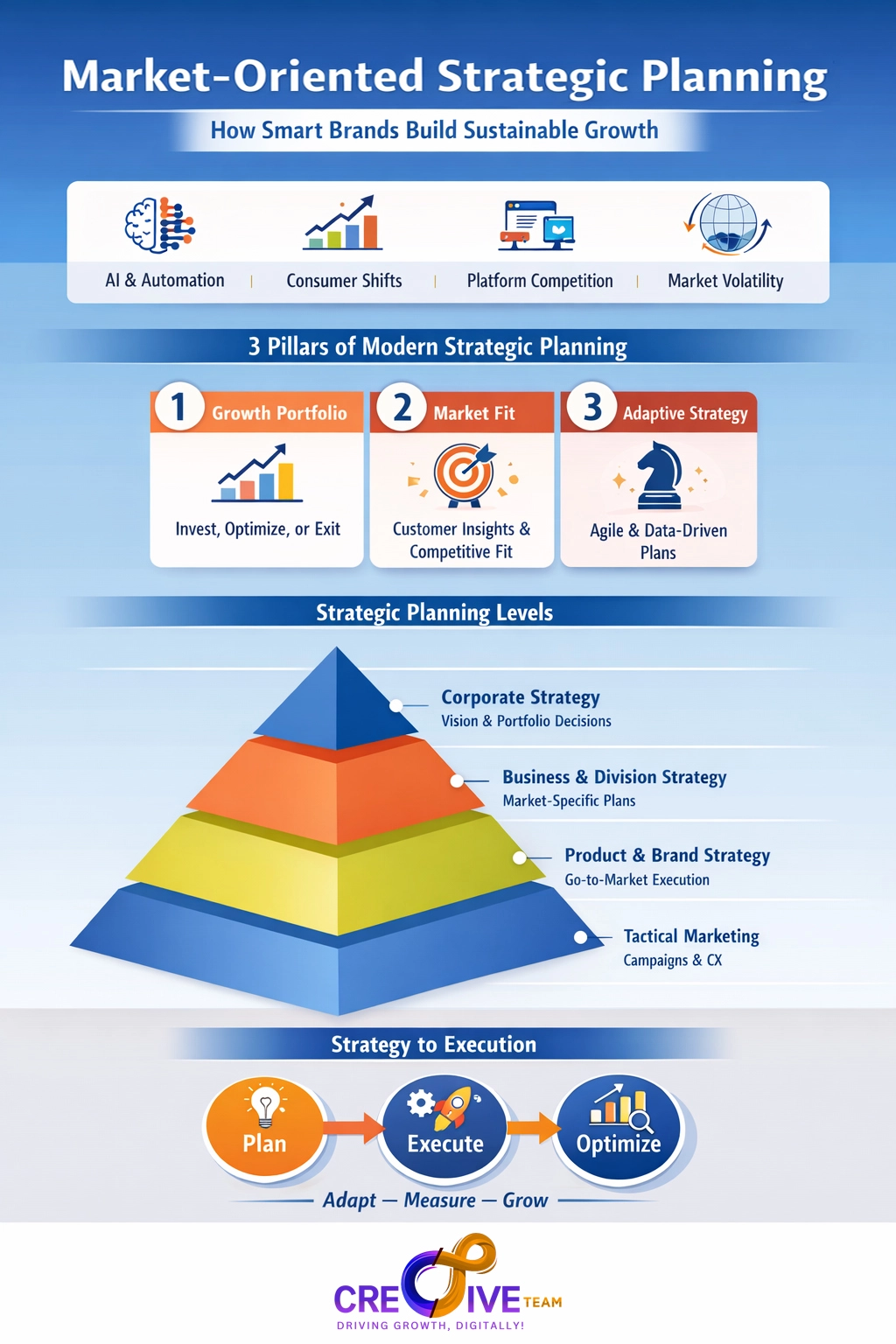
Market-oriented strategic planning means aligning your business goals with what the market actually needs, using the resources and skills you truly have. The focus is not just growth, but growth that can survive pressure, uncertainty, and change.

Planning Looks Very Different Today
A few years ago, many businesses relied on annual plans, fixed budgets, and predictable demand. That approach does not hold anymore, especially in markets like Pakistan.
- Cost instability
- Price sensitivity
- Digital competition
- Demand volatility
Because of this, strategy is no longer about predicting the future. It is about staying prepared when things do not go according to plan.
Strong planning does not remove risk. It helps businesses respond better when risk appears.
Strategy Is Not a File, It Is Daily Decision-Making
One common mistake is treating strategy as a document that gets approved and forgotten. In reality, strategy shows up in everyday choices.
It shows up in:
- Investment decisions
- Priority setting
- Customer focus
- Response speed
A market-oriented approach forces teams to keep asking simple but important questions. Is this still relevant? Is this still working? Does this still make sense for our customer?
When these questions stop being asked, problems usually start quietly.
Every Business Is a Portfolio
You do not need to be a large company to think this way.
Every business has activities that drive growth, activities that keep things stable, and activities that slowly drain time and energy without giving much back.
- Growth drivers
- Stable performers
- Resource drains
Good strategic planning helps separate these clearly. Instead of treating everything as equally important, businesses learn where to focus and where to step back.
This becomes even more important when resources are limited, which is the case for most growing businesses.
Market Size Matters Less Than Market Understanding
Many businesses chase large markets because they sound attractive. In practice, size alone does not guarantee results.
- Customer insight
- Clear value
- Simple messaging
- Consistent delivery
Companies that grow steadily are usually closer to their customers than their competitors. They observe carefully, test ideas, and adjust based on real feedback.
Where Marketing Fits Into Strategic Planning
Marketing is often reduced to promotion or advertising. That view misses the bigger picture.
Marketing connects strategy with the market. It turns direction into positioning, messaging, channels, and customer experience.
A strong marketing plan supports long-term business goals. It does not exist only to run campaigns or generate short-term traffic.
When strategy and marketing are not aligned, growth becomes expensive and unpredictable.
Growth Is Not One Team’s Job
Another important shift is that growth is no longer owned by one department.
Marketing, sales, product, operations, and leadership all influence how a business performs in the market. Strategic planning brings these functions onto the same page.
When everyone understands who the business is for, what it stands for, and what success looks like, execution becomes smoother and decisions become clearer.
Market-oriented strategic planning is not about perfection. It is about clarity, realism, and the ability to adjust.
The businesses that last are not the ones with impressive plans. They are the ones that stay close to their customers, learn quickly, and make practical decisions even when conditions are uncertain.
When done right, strategy becomes a quiet strength. You do not talk about it often, but you can feel it in how the business moves.